








In one line
China exported 10,151.861 tonnes of LFP cathode material in August, down 22.82% month-on-month. But almost the entire decline came from the United States — exports to the US fell by roughly 3,205 tonnes, while all other markets combined actually grew 2.84% MoM. This is not weakening demand. It is a re-routing of flows.
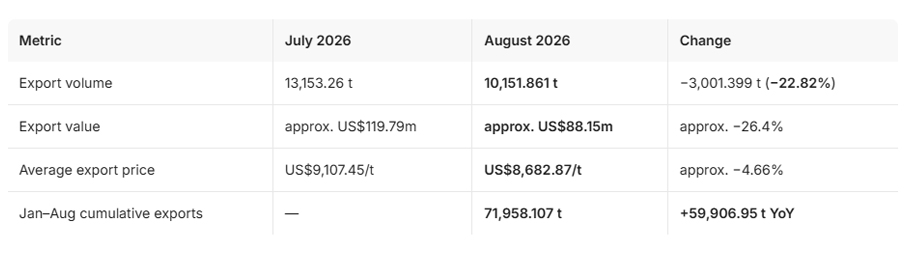
Value and price changes calculated by us from the published absolute figures.
Volume down, price down — but the cumulative picture is still one of rapid growth. Cumulative exports of 71,958.107 tonnes for January–August represent nearly 60,000 tonnes more than the same period last year. Against that base, August’s single-month pullback does not change the overall expansion.
Sharp monthly swings are structural, not directional
Customs export data is recorded at the point of declaration and shipment. Overseas battery and energy-storage projects procure against a sequence of commissioning, customer qualification, line ramp-up and delivery milestones, so material orders naturally ship in pulses. One large project shipping in a single month can move the monthly figure by thousands of tonnes.
The last six months of customs month-on-month data show exactly this pattern:
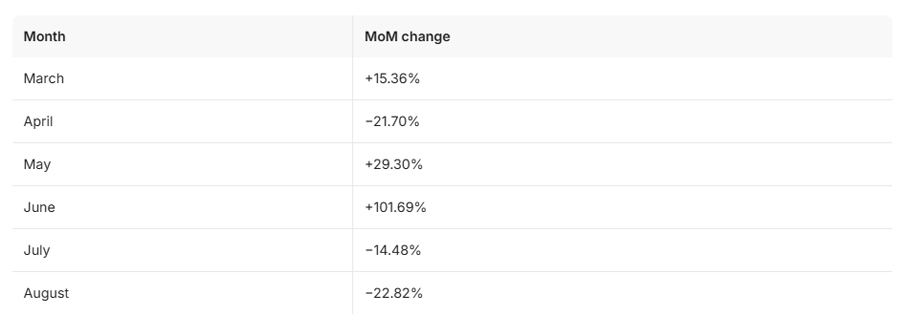
Three sharp rises and three sharp falls in six months, with the direction reversing repeatedly. Reading a trend from a single month will produce the wrong conclusion. A rolling three-month or half-year window is the minimum.
What really matters: the destinations have changed
August export volumes by destination (General Administration of Customs):
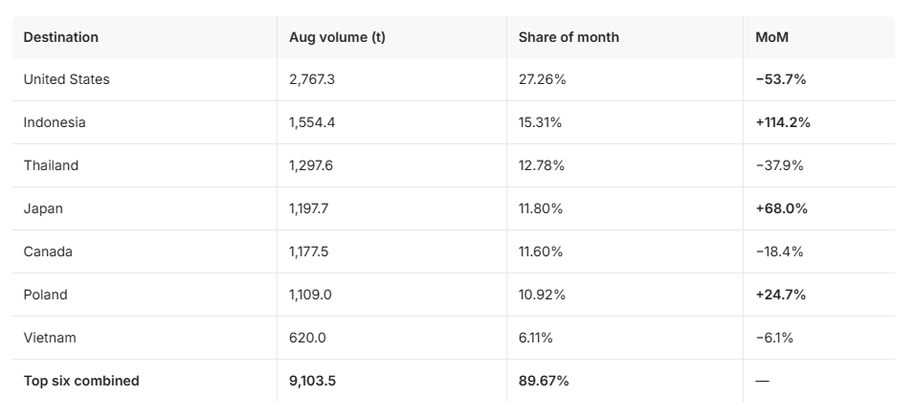
Shares calculated by us from the absolute volumes above. The top six are the US, Indonesia, Thailand, Japan, Canada and Poland.
The key calculation: one country’s decline exceeded the entire net drop
· Total: 10,151.861 t in August vs 13,153.26 t in July — a net decrease of 3,001.399 t
· Exports to the US: 5,972.529 t in July → 2,767.3 t in August — a single-month decrease of about 3,205 t
One market’s decline (about 3,205 t) exceeded the global net decline (3,001 t). It follows that:
· Excluding the US, all other markets combined totalled 7,384.56 t in August (10,151.861 − 2,767.3)
· Excluding the US, they totalled 7,180.73 t in July (13,153.26 − 5,972.529)
· That is growth of 2.84%
This is the single most important set of numbers in this article. It shows that August’s pullback was a structural cooling in one market, not a synchronised weakening of global demand. If your project is in Southeast Asia, Northeast Asia or Europe, the supply environment you actually face looks nothing like “exports down 22.82%”.
One further change worth recording: the top six destinations accounted for 89.67% of the month. Concentration remains high, but the centre of gravity is shifting from a single North American hub towards multiple regions — the US took 27.26%, while Indonesia, Thailand, Japan, Canada and Poland together took 62.41%. A single market’s swings now move the total less.
Material exports fell, but finished battery exports rose
This is the most direct cross-check on real demand. In August, LFP material exports fell — but battery-level and domestic installation data tell a different story:
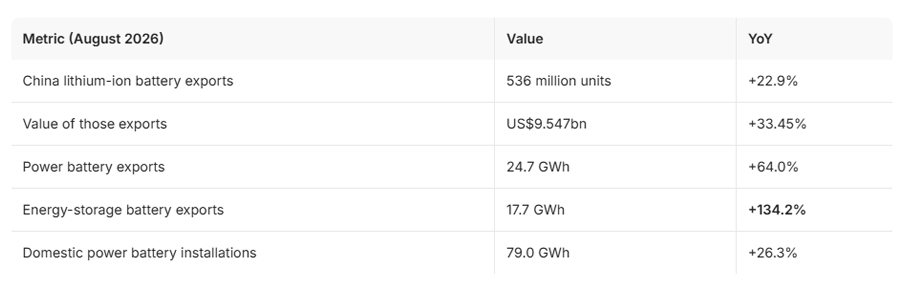
January–August cumulative: 3.69 billion lithium-ion batteries exported (+22.91%), worth US$67.549bn (+39.9%); domestic installations of 489.1 GWh (+17.0%), of which LFP accounted for 402.7 GWh — 82.3%.
Three takeaways:
- Demand has not disappeared — it has moved. While material exports fell, finished battery exports and domestic installations both grew at double-digit rates. Real downstream demand is strong.
- Value growth (+39.9%) continues to outpace volume growth (+22.91%). Overseas demand for Chinese battery products is concentrating in higher-value categories — energy-storage systems and large-capacity cells. For pack builders this means customers increasingly want a delivered system, not just a cheap cell.
- LFP accounted for 82.3% of domestic installations. The technology choice no longer needs arguing.
Export controls on 8 November: what buyers should prepare now
China has announced new export controls on “dual-use items” covering lithium-ion batteries together with cathode active materials (CAM) and anode active materials (AAM), effective 8 November 2026. Exports will require a licence.
For buyers, there are three practical consequences:
1. Lead time becomes a variable. Licensing takes time and is assessed case by case. Where previously you signed a contract and waited for production, there is now an administrative step before customs clearance.
2. Q4 is a time-limited window. Ahead of implementation, suppliers and overseas customers typically both prefer to ship early to reduce supply risk. If your project needs delivery in Q1 2027, completing your stocking in Q4 gives you materially more certainty.
3. A supplier’s compliance capability becomes a hard criterion. Before signing, establish clearly:
Whether the supplier is familiar with the dual-use licensing processWhether they can support compliance documentation such as end-user certificates
How responsibility and delivery are allocated if a licence is not granted on time
We recommend adding a clause to purchase contracts covering delays arising from export controls or licensing — whether timelines extend, whether liability is waived, and what the latest delivery date is. Writing this in now costs little; negotiating it after a problem arises costs a great deal.